I traveled far and long to the tropics of the distant south for winter break, like a migratory raptor a few months late on her journey. Except that Azerbaijan was not extremely far or extremely south or extremely warm, but it was 1000 kilometers to Baku and then a few more on the way back towards Naftalan.
 |
| Oil Workers Street in Baku (Neft/Naft is oil, a theme for this trip) |
 |
| A friendly baker who took our accidental invasion of her yard very well. Baku. |
Baku was lovely, I took the train there, ate way too much food because I was trying to try everything in two days, and met some interesting and kind people, but I'm not going to write about it in depth here because all I did was typical tourist stuff. I was not so kind to my Twitter followers though, so if you really want to see a bunch of buildings and fire mountains/temples/memorials from my point of view,
you may. I'll be back, since I have new friends to see & a still very long list of foods I want to eat. Plus my identification of some of the ducks on the shore was inconclusive (but I want to volunteer at the
Besh Barmag migration count someday, which I'm sure will more than solve that problem).
 |
| My fake husband & translator Matthew, and my new friend & guide (via Twitter!) Ana. Yanar Dag (outside of Baku). |
 |
| Trying to look casual, catching a glimpse of life as a young person in Baku with Ana - pomegranate wine, her friend's band, a long conversation about love & politics & change. |
Anyway, to the important stuff. Naftalan, city of dreams! I read about Naftalan earlier this year in this apparently Azerbaijan-sponsored
CNN article and immediately had to go. Naftalan is famous for its extra-thick crude oil, which is not good for the stuff oil is usually good for (aka making petroleum projects), but reportedly has healing properties. If you believe the doctors of Naftalan, it can treat over 70 skin, joint, and bone diseases, and has anesthetic and disinfectant properties, among many others. I did not believe them, but nonetheless I went, because where else in the world can you intentionally and legally bathe yourself in crude oil? I traveled with just one other volunteer, because apparently this idea does not appeal to everyone. Luckily for me the one that did come spoke Russian.
 |
| Took the train to Goran, and a taxi from there to Naftalan. |
 |
| The train. Goran. |
 |
| A sweet tower outside of the Goran train station. |
The legend of the oil's discovery has a caravan leaving a camel (I think I was told it was a shepard and a sheep but I'm not sure because... Russian...) behind that had fallen ill into a pool of oil. When the caravan returned some weeks later, the animal was miraculously healed. The first written record of the oil comes from 12th century Azerbaijani-Persian icon Nizami, a poet who wrote about its export in trade caravans. A hundred years later Marco Polo referenced "anointing the camels in maladies of the skin, and for other purposes; for which reason people come from a great distance for it." For the record, tragically, I saw not a single camel in Azerbaijan.
 |
| Naftalan alternates between cultivated lushness |
 |
| and golden flatness. |
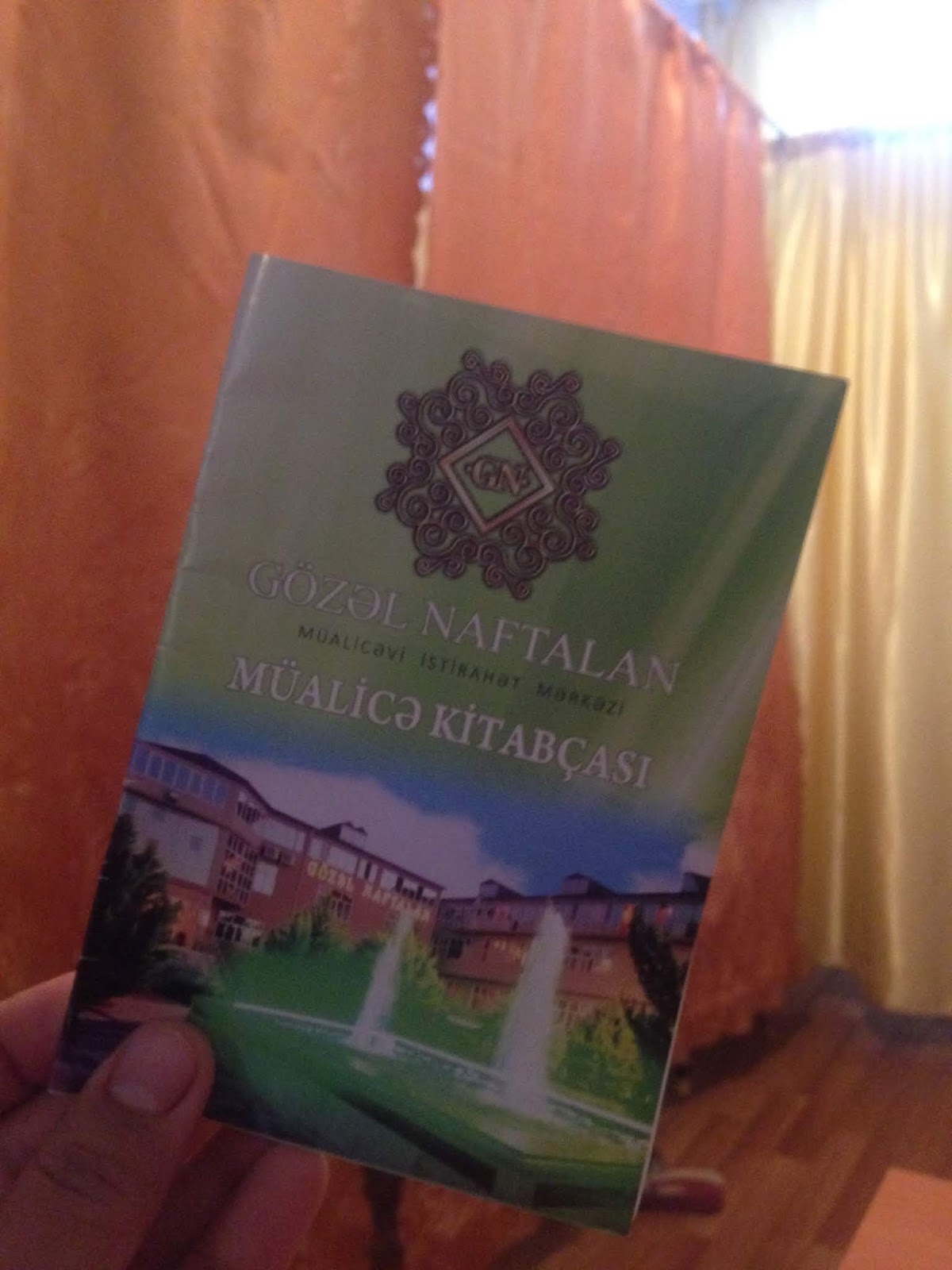
The CNN article refers to the fancy resort in town, Qarabagh, named after the partially-disputed region (often spelled Karabakh, also known as Artsakh if you're in Armenia in the last few years) whose beautiful snowy mountains you can see to the west of town. Qarabagh is $70 dollars (the Azerbaijani currency is the manat, but I will use US dollars in this article for the sake of my main reader) per night, including oil treatments, room, and three meals a day. I did not stay there. I stayed at Gozel Naftalan (Beautiful Naftalan) Health Resort instead, at a much more reasonable $24 per night, though a teahouse conversation told us it would only be like $17 if we hadn't booked online. Oh well. It is the cheapest one on Booking.com. Like in Baku, the old Soviet buildings had been mostly torn down or extensively renovated, so all the resorts look fairly new though the inside of my room was a bit more of a period piece.
 |
| The front of this building never receives sun, I don't know how it's possible but I tried for three days to get a better pic. |
 |
| View from the cafeteria, mountains to the east. Naftalan. |
When we arrived on the first afternoon, after paying twice the normal cab fare (if only I was the one who could argue in Russian!) we were immediately taken to our rooms without them asking who we were, and the staff (the director and his assistant) stood outside our rooms while we put our stuff down, took us to the lunchroom, and then immediately to begin our treatments. Once I decided to go to Naftalan I had stopped doing research because I don't like to know too much about the places I'm going in advance, so I was just expecting an oil bath and nothing else. This was not the case.
 |
| Welcome. Naftalan. |
The first thing we had to do was take a cardiogram, but this was not the cardiogram that I have seen in American hospitals. Instead of plastic bits there were little metal cups attached to little balloons that suctioned to your body. Apparently all was well, because I never saw the results or heard about them again. The next step in the medical examination process was them asking if I had any breathing problems, and then we were done and ready to go! They still had not asked for our passports or payments. I was still in my lace-shirt-fancy-skirt-and-stockings travelling outfit, which I then was forced to remove and then put back on parts of in about 7 different small rooms. I was more ready the next day, since the schedule is more or less the same every day, though we got a late start on day 1, after lunch.
 |
| I wasn't ready for the cardiogram so I didn't get any pics. Here's some other device. Naftalan. |
The schedule began every day with breakfast at 8 am, followed by "physiotherapy" treatments in any order, the oil bath, some rest, lunch at 12:30, free time, and then dinner at the obscenely early hour of 5:30 pm.
 |
| Lunch. Soup, salad, greens, & then a meat dish (some form of rice or potatoes with 1 meatball or 1 chunk of lamb). Naftalan. |
The first treatment was a naftalan oil massage with a small metal appliance that a woman moved in small circles around my back. The oil was apparently a refined version of the brown gunk we were to bathe in, and was applied my back with a paintbrush. The thin yellow oil looked like baby oil or cooking oil, but it definitely smelled more toxic. I don't know what this treatment was supposed to do exactly, but she was delighted to have me there. Almost all of the women were; I think I was an exciting change from the normal crowd of 50+ Russians and Azerbaijanis. They kept calling me a beautiful chocolate Barbie, which was weird but well-intentioned.
 |
| The massage appliance was attached to this box. IDK. Naftalan. |
 |
| Waiting for my treatment, tea & moon pies. Naftalan. |
After the appliance oil massage I received some sort of electric current treatment on my back, since they had asked what hurt (I guess they assume you're not there for fun), and my back and shoulder had actually been in quite severe pain for several days. For this one they put a warm wet towel on my back and then attached two little nodes to a machine that sent the current, and then put a blanket on me and let the electricity do its job. Halfway through the technician changed it to a sort of pulse instead of a constant current. Unfortunately for me there doesn't seem to have been a set level, so the technician just chooses a random one and assumes you'll tell her if it hurts. This becomes a problem if you only know how to say "thank you" in Azeri and various food words in Russian. On days two and three they mixed it up and I got the electric current treatment on my knees instead, but one of those also hurts from a residual rugby injury, so that was fine.
 |
| A flattering angle~ Naftalan. |
 |
| This cruel machine, made more charming by the addition of pinecones. Naftalan. |
Next was a paraffin-naftalan back treatment(almost every treatment seems to involve naftalan oil in some way), in which a thick layer of wax was applied to my back, and then I was covered in a layer of bubble wrap and another thick blanket, and left to lay for 10 minutes. Every treatment takes 10 minutes. Afterward the technician comes by, scrapes the wax off, and then returns it to the melting pot. Don't think about it too much. Once again, I have no idea what the purpose of this was, but after the initial scorching hot wax feeling it felt kind of nice. To visualize, imagine three cots in an office, separated by shiny orange and yellow curtains with scalloped rims. You bring your own sheet (from your room) and put it on the cot in every room (almost every treatment has its own room), and then wait for the technician to finish the old man next to you. You can hear him laughing or gasping at the pain, or the videos he watches on his phone while he waits for the 10 minutes to be up.
 |
| The wax off my back. Naftalan. |
 |
| Waiting Room. Naftalan. |
After this I went to another room where the technician brushed more oil, this time on my legs, which were in a sort of wooden tube with heat lamps, covered by a blanket. On day 1 I didn't have the wifi password yet, so I just stared at the curtains. No idea what this treatment was supposed to do.
 |
| Pre-blanket, a mystery. Naftalan. |
The next treatment was with a strange red-lit device with a much milder electrical current that the technician moved around my legs and feet in small circles. On days two and three it was my head, with a comb-shaped attachment instead of day one's blob. This felt sort of nice and sort of strange. The technician called her English-speaking fiance on day two to explain. It is apparently good for your blood.
 |
| A very sweet technician. I forgot her name already though :(. Naftalan. |
 |
| Rhinestones & Allah desk display. Naftalan. |
 |
| Where the magic happens~ Naftalan. |
The penultimate treatment was a classic massage, which probably did more for my shoulder pain than any of the other more complicated treatments. What a luxury for a Peace Corps volunteer though, a 10-minute massage, three days in a row!
 |
| Treatment book! Carry it with you always. Naftalan. |
 |
| The list. Accepting translations or explanations... Naftalan. |
And finally: the baths. After all of the treatments to soften your muscles and warm your feet and move your blood comes the reason for the day, the oil bath. You buy a sponge and extra shampoo before going in, and bring the weird yellow towel from your room. You are ready. You go to a small changing room and take off all your clothes and hope that was what you were supposed to do, and then an older woman (or a man if you're a guy) walks in and takes you to your bath. Mine was initially half empty, with a cinder-block in the middle that I was told to sit on, while the bath filled up with warmish, viscous, & dark golden-bronze oil. In retrospect, I think she just had me sit on the block on day one because it was later in the afternoon than they normally work and she didn't want the hassle of scraping the oil of my entire body. On the other two days I got to sit all the way in the tub, though the cinder-block was still there sort of awkwardly between my feet. On one day the oil was on the cooler end of lukewarm, and was not as enjoyable as it could have been. On every day the woman helping me sat there and watched me for the full 10 minutes. I wasn't sure if it was more or less awkward that we could barely talk because of my atrocious Russian. Then she helped me up (a bathtub full of oil is slippery, who knew?) and used a metal spatula to scrape off the first layer - it's thick, and stays on in an opaque layer otherwise. Afterward we worked together to get off the rest using tissue paper, and then we went to the shower, where she sponged the first layer of oil off my back before leaving the rest of the job to me. It usually took three rounds of head-to-toe aggressive soaping, and I still left with a faint odor of oil, but I kind of liked that part.
 |
| Proof. Naftalan. |
 |
| My tub, my cinderblock, my <3. Naftalan. |
 |
| My sponge, rip. Naftalan. |
On day two we were also invited to participate in 8 am urine and blood testing in the basement of the sanatorium. I politely but firmly declined to have my blood tested while on vacation, and they never told us the results of the urine test, but hopefully it was fine.
 |
| Naftalan products for sale in town. I got the 3 manat cream instead of the recommended 20 one, sorry I'm a Peace Corps volunteer. Naftalan. |
 |
| The source. Naftalan. |
The oil bath (and the rest of the treatment) is supposed to solve all of your problems, especially skin conditions and joint problems. There is a Crutches Museum in town, full of the crutches left behind by people who were miraculously healed in Naftalan, but it was unfortunately being renovated during our visit. Naftalan is 50 kilometers away from Azerbaijan's second largest city, Ganja, and there wasn't much else to do in the afternoons post-treatment. We drank tea at numerous teahouses, and I was thankful to be traveling with a guy since they're very male-dominated environments. There was a bakery, a mosque we didn't go inside, two shawarma shops, a cemetery, some deserted buildings, some very new buildings, and a grocery store, my favorite. Mostly there was just walking - around town, in the park, through another park, in the fields and emptiness on the edges of town. You could see the mountains of Nagorno-Karabakh on one side, and some other ones a bit further away on the opposite side, both covered in snow. On one walk we visited the source of the famous oil - a few big storage tanks, accompanied by a guy and a dog and a big fence. The stream running by had a layer of black oil floating on the top, and nearby oil derricks were pumping out more for our baths.
 |
| Döner in Naftalan. Basically like Georgian shauarma, unfortunately. |
 |
| Some nice grass, doesn't take long to walk out of town. Naftalan. |
 |
| Creeks running half black. Naftalan. |
 |
| :D Naftalan. |
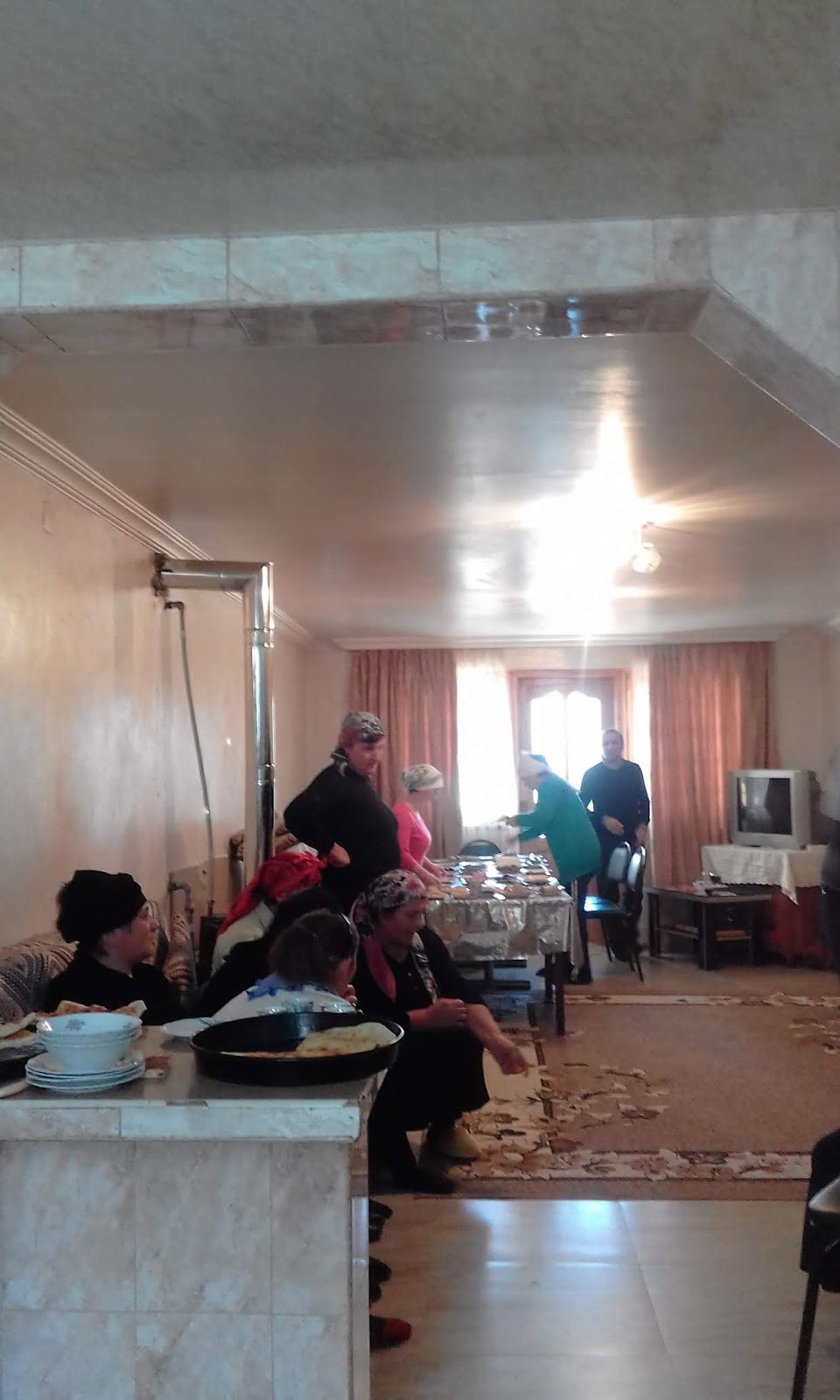
Exploration time was limited by the winter sunset and the set dinner time of 5:30 pm. On one night there was a concert (a guy with an electric keyboard and a mic doing covers) and dinner was delayed till six while some of the kids staying with their families danced around. The food was actually quite good - simple, healthy, but still Azeri enough that that I didn't feel like I was missing out by eating at the same place for most of the trip.
 |
| Cafeteria. Naftalan. |
 |
| Supplemented beverages: pomegranate wine & Turkish magnesium water (good), Azerbaijani cognac & Siberian grass soda (not as good). Naftalan. |
 |
| Dinner - a meatball, potatoes, greens, salad, ayran, bread, sweet bread for dessert. Naftalan. |
While I obviously loved every part of this trip deeply, one of my favorite things was the variety of people we met. All of the other visitors (about 30, with a max. resort capacity of around 300) were Azerbaijani or Russian, but Russian in the sense of citizenship rather than ethnic identity. This was a new experience for me - I've read about the ethnic diversity of Russia, especially as it pertains to Soviet nationality policy and so on, but I'd never really experienced it, and suddenly we were sitting at a table with a couple from Makhachkala whose native language was Tabasaran (I'd never even heard of it before) while they told us about some American guy who lives in a village somewhere else in Daghestan with his six kids and speaks fluent Tabasaran, or we were walking around town and met a group of older women from our resort who were Tatars from Udmurtia, talking about how difficult the Udmurt language was (they didn't speak it, and once again I had never heard of it).
 |
| Our Tatar friends. They were not impressed with the resort food & were on a doomed mission to find better. Naftalan. |
 |
| An friendly Azeri guy who I think said his name was Phillipe at a 1940s teahouse. Naftalan. |
Naftalan was a beautiful place to visit, calm in the winter but with signs that it becomes quite lively in the summer. If I didn't expect to have to do remedial language training before graduate school I'd deeply consider coming back after Peace Corps and staying for the recommended month. It's peaceful, cheap, interesting, everyone was kind, & I learned a lot. What more do you want from a trip? I still have to visit the renovated crutches museum...
 |
| I already regret not buying one of these, but I was out of cash. Naftalan. |
 |
| Tin roof decorations abound. This one was my favorite. Naftalan. |
 |
| Plane Tree. Naftalan. |
 |
| Abandoned building lurking, my specialty. Naftalan. |
 |
| Back in Georgia. Red Bridge. |