Showing posts with label adjara. Show all posts

Tuesday, January 1, 2019

Books of 2018

Outbox - only the latest editions here.
Before I came to Peace Corps, everything I read talked about how I would have so much time that I wouldn't know what to do with myself, and that when I came back to America I would miss that. I don't believe that will be case. Peace Corps Georgia seems to lend itself to overwork by volunteers, and between my lessons, English Club, collaborations with regional groups, my work writing grants for GLOW, my English Cabinet renovation grant, language learning, Peace Corps trainings and meetings and tasks, personal writing projects, community relationship building, grad school applications, and general life (and fun things like exploring all ends of Georgia and showing visitors around and growing plants), I'm busier here than I ever was in the U.S. - I never got home from work there and then sat at my computer to work for another 4 or 5 hours, but that has been the case here on many more than one occasion.

Nonetheless, my remote location has provided me with some time to read, in the form of excessively long public transit journeys - 9 hours to Tbilisi, 2 hours just to my closest city. But I am blessed to be able to read on marshutkas, and so here we have it: a list of what was read in 2018. Not quite a book a week, but not terrible. The good, the bad, the dumb:
  1. Red Journeys: Inside the Thai Red-Shirt Movement - Claudio Sopranzetti - first week of January: This was a long time ago. I know almost nothing about Thai history or politics (ok, a lot more than the average American, but a lot less than the average Thai), so this slice of life/protest experience book was a little confusing, but still interesting. Plus! It was a book in English, which is much more common on the island (I was visiting my dad in Thailand) than it used to be, but pickings are still slim.
  2. Stalin - Unknown Author - early January: Another random island book, this time a Soviet biography of Stalin published in 1947 or 1949 (I gave it away so I don't have any of the details). A simplified depiction of events, no famines, almost nothing about Georgia that I recall 11 months later. 
  3. Confronting the Classics - Mary Beard - late March: A gift from a wetland ecologist friend, who was reading it and then no longer wished to carry it. My classics education has been somewhat slim, not much beyond some early childhood acting as Hestia, goddess of the hearth, some books of Greek myths for kids, and AP Art History in senior year of high school, so while this book presented some intriguing perspectives on the study of classics, I feel like I have quite a bit of reading to do before I can have any of my own ideas on these topics. Reading this before reading the "classics" does provide some good background and a large pile of salt to consume while reading.
  4. The Far Away Brothers - Lauren Markham - sometime in spring: My mom's cousin's book about the lives of two Salvadoran students at the immigrant and refugee high school she works at, that I also volunteer taught at for the summer before I came to Georgia. A timely and empathetic insight into the refugee experience, and something I think more Americans should read, especially in this time of caravan scares and border walls.
  5. The Iliad - "Homer" - finished in the first week of May: See above for explanation, the first "classic" I found in the Peace Corps library. An easier read than I was expecting because I always get it confused with The Odyssey and then I confuse that with Ulysses. Probably better in Greek or if I knew what dactylic hexameter is. I'll get there eventually.
  6. The Catcher in the Rye - J. D. Salinger - first week of May: Fruits of the Keda Center for English Education library. If only I had read this during the angsty high school years. It was fine. Made me miss America a little bit.
  7. A Clockwork Orange - Anthony Burgess - first week of May: Another Keda library hit. I distinctly remember trying to read this in 9th or 10th grade and being so frustrated with the "made-up" words that I stopped after a few pages, a rare thing for me. Now that I've finally read this, all that's left on that list are the Bible and Salman Rushdie's Shalimar the Clown (a failed attempt at reading what my mom was reading in middle school). Anyway, after a year of college Russian the fake words make much more sense, and it was a fun, occasionally cringe-inducing read. I've never made it to the end of the movie either (it's something that people always seem to put on at the end of the night & then I immediately go to sleep), so I have no idea how it compares.
  8. Salvage the Bones - Jesamyn Ward - end of June: Another book that I think all Americans should read, this one about the experiences of one family during and after Hurricane Katrina. Despite being aware of news coverage at the time and then living in New Orleans for college, I don't think I have ever come as close to understanding what it's like to live through a hurricane and its attendant devastation as I did while reading this book. Thanks mom for sending me books to keep up with the literary world outside of the Peace Corps library :)
  9. Redbreast - Jo Nesbo - first week of July: I have a soft spot for Nordic thrillers ok?
  10. Sindbad the Sailor - Unknown Author - last week of July: A book found on the free table in the Peace Corps office and foraged for my school's library. Charming, short, reminded me that I should read the whole One Thousand and One Nights.
  11. The Valkyries - Paulo Coelho - 9 August 2018: Another free pile salvaged book, not my style at all, but the western desert settings reminded me of happy road trips through the Eastern Sierra, and Death Valley and so on. Put it in the school library but I don't anticipate any of my students reading it any time soon. 
  12. The Possessed - Fyodor Dostoevsky - sometime in August: At this point I think I have read almost all of the English language novels in the Keda library. I am usually a fast reader, but this put me to sleep every time I read a few pages, so it took months. I carried it to Tbilisi and back home, from Mestia to Ushguli on foot, and a lot more places. I assume it's better in Russian. Someday...
  13. Middlesex - Jeffrey Eugenides - sometime in October: Probably my favorite book this year, and one that I have no idea about going in, except that other people also thought it was good. I especially enjoyed the descriptions of life in Turkey in the early 1900s and the Greek diaspora, though I asked a former professor of mine who studies the Ottomans and World War I and also happens to be from Izmir (which is mentioned in the book in its Greek name, Smyrna) about the depiction and he said to keep the 19th and 20th century British mindset in mind while evaluating accuracy. A great story about the 20th century American experience, covering so many aspects of life while still staying utterly engaging. I was sorry to reach the end. 
  14. Dead Souls - Nikolai Gogol - early November: Brought back traumatic memories of the Performance class I was forced to take in college back when I wanted to be a lighting designer. We had a Russian visiting professor in the department that year, and spent an excessive amount of time on Gogol short stories, which was fun until we had to do performance activities in response to them. For the record, I got an A though the professor said he had never had a student who hated his class so much. Anyway, it was fine, though not as funny as some of the short stories, an interesting look at 19th century Russian life. More importantly, after reading it I started noticing regular references to "dead souls" that wouldn't have meant anything to me before - "dead souls" rumored on Georgian voter rolls, "Dead Souls" as the title to a song on my favorite Joy Division album (Les Baines Douches, obviously), and it's a book I can refer to in conversation with older Georgians (i.e. my Georgian tutor). Valuable for it's influence for sure. 
  15. The Hobbit - J. R. R. Tolkein - early November: Somehow never read this during my high fantasy days (aka like every day from 4th through 9th grade), despite reading all of the Lord of the Rings books. A delightful one.
  16. The Lord of the Rings - J. R. R. Tolkein - mid November: You know.
  17. The Fellowship of the Ring - J. R. R. Tolkein - 18 November 2018: See above. 
  18. The Return of the King - J. R. R. Tolkein -  19 November 2018: #3.
  19. The Picture of Dorian Gray and Three Stories - Oscar Wilde - 23 November 2018: Oscar Wilde is insufferable and so are most of his characters, but still a fun read. I enjoyed the filler stories more than The Picture of Dorian Gray. 
  20. Dissolution: Sovereignty and the Breakup of the Soviet Union - Edward W. Walker - early December 2018: Another one that took me over a year to read because I kept opening it and promptly falling asleep. I started reading it before coming to Peace Corps because it was one of two books about Georgia (in part) that I could find at my local used bookstore before coming here (I went every week for a few months and asked if they had anything about Georgia, they thought I was insane, love you Moe's). Glad I finished it though, I feel like through school and other stuff I've learned a lot about the Soviet period, and through living in Georgia I learned a lot about the post-Soviet experience, but while reading I found that a lot of the assumptions I had made about the break-up were wrong, and filled in some very large gaps in my knowledge, especially regarding the Abkhazian and South Ossetian conflicts, even though not much space in the book was devoted to them specifically. 
*Also a wide variety of books for young children, abridged versions of classics, etc. for classroom purposes & because they're what I have in the village...

In progress...
I am currently very slowly reading:

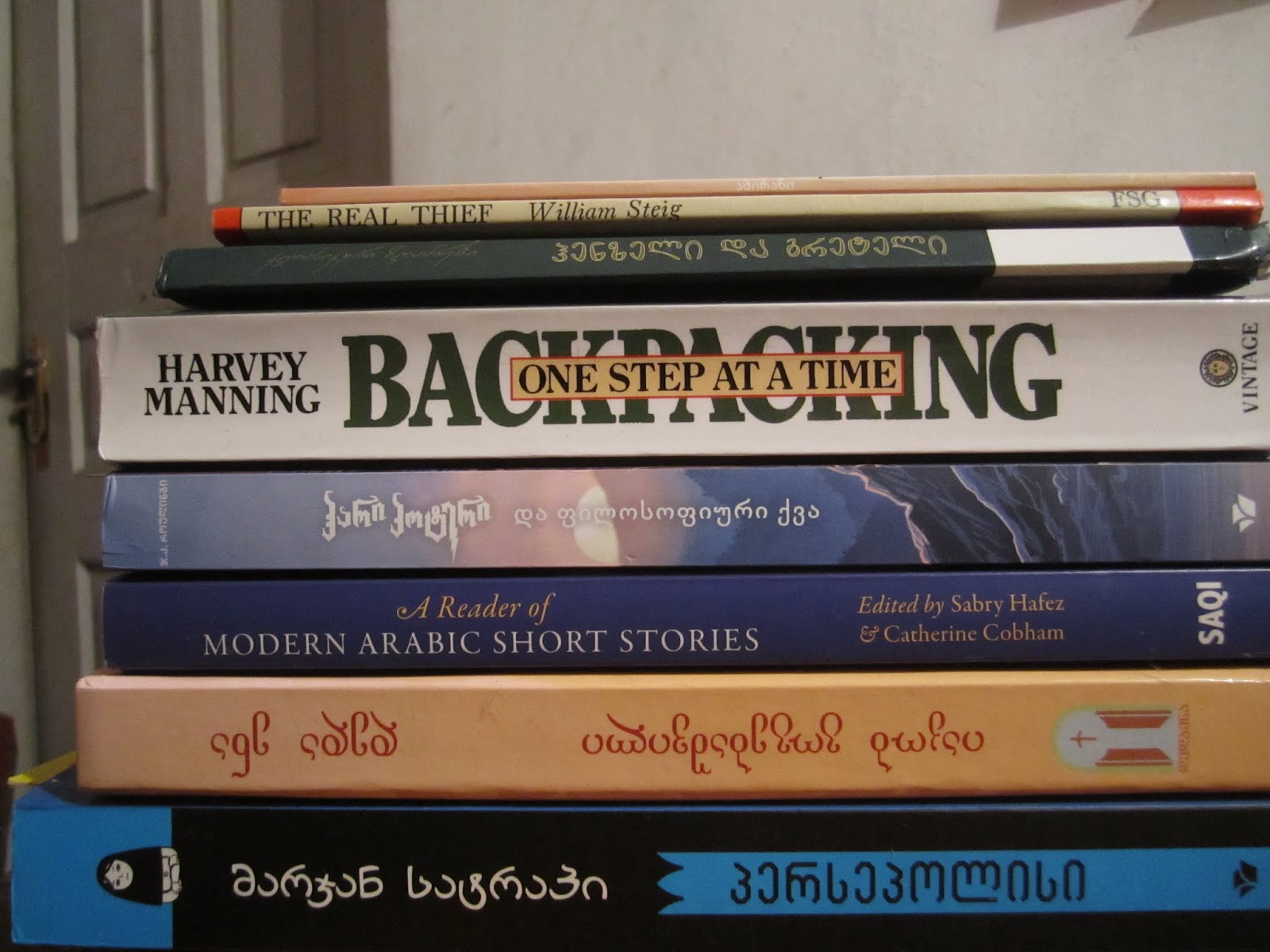
  1. A Reader of Modern Arabic Short Stories - Edited by Sabry Hafez and Catherine Cobham: (Arabic & English) Kill me.
  2. Amirani and Hanzel da Greteli: Georgian children's stories, shouldn't be taking as long as they are.
  3. Hari Poteri da Pilosofiuri Qva - J. K. Rowling: The Georgian translation obviously. Gonna learn some useful words!
  4. Persepolisi - Marjane Satrapi: A graphic novel in Georgian! Easy, right? No.
  5. Backpacking: One Step at a Time - Harvey Manning So many details about methods of waterproofing clothing! Wau!
  6. Deda Ena - Iakob Gogebashvili: The classic first grade text. Also the reason I know a million animal names but nothing else in Georgian.
  7. The Real Thief - William Steig: A children's book about a goose. I keep leaving it weird places so I still haven't finished it even though the student I was supposed to be asking about it returned their copy long ago.

Also, shout-out to my reference books. 
Finally, I spent a lot of time with A Field Guide to Birds of the USSR, the Lonely Planet Guide to Georgia, Armenia, & Azerbaijan, my dictionaries & Georgian textbook, and Forsman's The Raptors of Europe and the Middle East: A Handbook of Field Identification.

Wish me luck for 52 books in 2019, and as much learning as I did in 2018!

Coming up next...

Sunday, November 4, 2018

Batumi Raptor Count

Sunrise in Sakhalvasho
This summer and autumn I had the opportunity to work with the Batumi Raptor Count, a monitoring project that counts birds of prey as they migrate through Batumi. Birds from northern Europe and Russia fly through, headed to anywhere from Sub-Saharan Africa to Turkey, and birds that don't like to fly over the sea congregate in a narrow area near Batumi, west of the mountains and east of the Black Sea. The BRC counts certain migratory raptor species as they fly through every autumn, and has been doing so for 11 years, collecting data for scientific research, educating the public, and working on various other projects. They count over a million raptors every year, a hard-to-imagine number, even having witnessed a lot of it!

Casual morning views from Shuamta
Because of my school schedule, I couldn't make it for the required two-week stay all at once, so I volunteered to count for a week at the end of August, a weekend in September, and then a few days in October. While this isn't the standard counter experience, it was nice for me to see the different types of birds (lots of honey buzzards in August, eagles in September, steppe buzzards in October), and to meet almost all of the other counters, who come from all over Europe, plus another American and one from Mexico. Due to a preponderance of counters and coordinators from the Netherlands, in addition to learning a lot about birds, I also learned much more than I ever knew about Suriname. It was fun to be in a group of people from so many different places, and with so many people so passionate about birds. There was a conversation entirely made up of funny stories about gulls.

A Chinese Screw Orchid, a native orchid species on the stairs to the Shuamta station.
The BRC counts from two hilltops just outside of Batumi, in the villages of Sakhalvasho and Shuamta. Counters stay with families in the villages and eat breakfast and dinner there, with packed lunch to eat on the station. The families I stayed with were both very sweet, and delighted to have someone that spoke Georgian around. Sakhalvasho is across from the Mtsvane Kontskhi (Green Cape), a lush bit of the coast that contains the Batumi Botanical Garden, and overlooks the sea. The hills are full of terraced mandarin orchards, and at night, despite the proximity to the city, the sky is alive with bats and birds and you can hear the jackals howl. Shuamta is deeper into the mountains, up a windy road past old tea plantations, and the house we stay in is basically at the end of the road - no traffic, just trees and cows.

Shuamta's inexplicable coffee shop.
Tourists birdwatching from the cafe in the middle of nowhere, Shuamta.
A typical count day begins with pre-dawn breakfast (I can't eat that early, so I would take breakfast to the station, where some sneaky station animal would try to steal it), and then a 15 or 20 minute uphill trek to get to the station for sunrise. In August the count ran from about 6 am to 6 pm, which was brutal, but the days were significantly reduced by the middle of October, when the count ended. The first hours were often slow, but beautiful enough that no one minded staring at the empty sky for a while. This was a good time to pet the dogs or cat that often joined us in the morning. As the day warmed up birds would begin streaming by, including massive groups of buzzards, lines of Black Kites, more solitary eagles, falcons, Chaffinches, European Rollers, and my new favorite bird, the European Bee-Eater. Bee Eaters are a lovely colorful bird with the most cheerful, burbling call. Some days were full of birds, with over 100,000 birds counted on a least one day, and some days were much slower - just a few hundred birds, with 7 people counting for 8 hours or something like that. Lots of time to think your thoughts and admire the sea then. I got my first sunburn in a few years, since I showed up to stand in the sun for about 72 hours with no hat, sunglasses, or sunscreen. I came a little better prepared for my next two visits. Days ended with a beer, a review of who saw what at which station, a delicious dinner, and then either everyone going to sleep immediately, an educational session (in case you want to learn about Egyptian Vulture conservation in Bulgaria or whatever), or everyone going to the "bar" in Sakhalvasho, for strawberry chacha and beer drunk while sitting on tree stumps.

Station dog, Sakhalvasho.
The actual counting is more or less what you'd expect. There's an imaginary line running from the mountains to the coast, and counters count birds as they cross it. The BRC mostly counts migratory birds that don't really have resident populations in the area, so the chance of counting the same bird multiple times is reduced. Walkie talkie communication and distance codes and other techniques help ensure that birds aren't counted by both stations, and coordinators at each station assign roles to make sure everything goes smoothly. Most of the birds are very far away, birds that I on my own would probably have written off as "some bird," but the more experienced counters and the people with fancy equipment, are very good at identifying things that look to me like fleas hopping on distant clouds. The BRC does do some evening sessions on how to ID different types of birds, but a lot of those were beginning at a level slightly beyond mine - like how to differentiate harrier species, while I needed to learn what a harrier was. I tried. Sometimes they would ask for someone to just click numbers of birds flying by while someone else did the species (and sometimes also the age and sex and color). That I could do, especially if the birds were near enough to be seen with the naked eye, and I always felt quite accomplished after counting even a small stream of birds. Just as I was beginning to feel like I could ID a few of the most common species though, the count was over. I understand why they ask for a two-week commitment.

Right before it starts burning your eyes out, Shuamta.
Volunteering with the BRC also gave me several opportunities to teach Georgian students about birds, conservation, and the BRC project. I brought a group of students from my school to Shuamta, visited the Sakhalvasho school for some guest lessons, and even visited Kolkheti National Park with a group of young falconers, though in that case I think I learned more from them. I also attended a presentation entirely in Georgian on the topic of sturgeon conservation, which I actually understood most of, a nice feeling for sure.

The Kolkheti Wetlands reminded me a lot of New Orleans.
Not a lot of birds in the middle of the day, but I saw three kingfishers, Kolkheti National Park.
Dock dog, Kolkheti National Park.
The school that I teach at, in the mountains of Adjara about 2.5 hours from Sakhalvasho, is very small, with only 40 pupils, and does not have a lot of resources, especially with regards to their science curriculum. Almost all of their learning is from textbooks, with few opportunities for fun and hands-on experience. Because of that, being able to visit the Batumi Raptor Count was a very exciting experience for my students and the two Georgian teachers that came with us. While there were not so many birds in early October, they were happy to use the binoculars and scopes to look out at Kobuleti and Batumi, and see some familiar places from a new vantage point. There was one distant kettle that had some of my students fighting each other for scope time though! They also learned about the different types of birds that fly through Batumi, why Batumi is such a unique place, and about why the BRC monitors migration, while admiring the view from Ruslan’s lovely yard. Despite the long drive, everyone who came was awed by the beauty of Sakhalvasho and Shuamta, places almost none of them had ever visited, and delighted by some strange mushrooms we saw, the struggle of our marshutka heading up to Shuamta, and the few birds we did see.

Does everyone look like they're having fun? (Sakhalvasho)
The lesson: bird parts, what birds, a bird word crossword, Sakhalvasho. 
I also had the privilege of working with Sakhalvasho English teacher Elza, who invited me to visit her 3rd, 7th, and 11th grade classes. Most of the older students were at least somewhat familiar with the BRC, so I took the opportunity to play “Bird Jeopardy” with them, a fun way to practice their English vocabulary and bird knowledge, and hopefully more entertaining than a slideshow lecture on migration. While everyone could answer “Where does a cuckoo build its nest?” the question “What do bee-eaters eat?” completely stumped two entire classes of 7th and 11th graders. I didn’t bother trying to teach a group of 3rd graders about migration flyways and the different types of buzzard, so instead we sang some silly songs about birds and looked out at a small kettle that had formed outside their classroom window.

3rd grade bird song time in Sakhalvasho.
11th grade group pic, Sakhalvasho.
These experiences help develop students’ appreciation for and interest in birds, nature, and conservation, and hopefully some of them will go on to become Georgia’s future scientists, teachers, and BRC counters. And hopefully I can join the count again someday, if not this spring then in some future year. I spent this whole experience trying to cram new information into my brain, and I want to have the chance to use it again!

Beqa lookin' for birds in Shuamta.
Reading about raptors on the ride over from Keda.
My counterpart Nineli & I, with 5th grade Lizi.
Last day party, with counters & Georgian hosts (I'm behind the camera), Sakhalvasho

Wednesday, August 22, 2018

Eids aka ბაირამები aka أعياد

The neighborhood men working on 2017's cow, a collective project (Keda, Georgia)
Eid al Adha (or Eid al Kabir in the Maghreb or Kurban Bayram in Turkey and Georgia), or the Feast of the Sacrifice, is on of the two holidays celebrated by Muslims across the world. Eid al Adha is considered the holier of the two, and honors Abraham's willingness to kill his son Ishmael on god's command (the Muslim version of the story differs slightly from the Christian and Jewish versions in which Isaac is the son to be sacrificed). The holiday begins on the 10th day of the 12th month of the Islamic calendar, Dhu al Hijjah, during which many Muslims are also on hajj (pilgrimage) in Mecca. This year, that corresponds to the 21st of August. Celebrations differ across the world, but one thing they all have in common is the sacrifice of animals, representing the animal that Abraham found under his knife as he prepared to sacrifice his son on Mt. Arafat.

Eid al Fitr in Ibri, Oman 2015

Eid al Fitr, the other widely celebrated holiday, marks the end of Ramadan, the 9th month of the Islamic calendar, during which devout Muslims fast from dawn to sunset every day. Muslims give money to the poor (and often any children in the household) before saying the special Eid al Fitr prayer.

Visualize Keda summer- hot, rural, humid, hills, perfect (2018)

I have now had the privilege of experiencing both Eids with three very different host families, in Morocco, Oman, and Georgia. I'm from a basically agnostic Thai Buddhist/Catholic (?) family, so grew up on typical American Christmas, with lots of presents, an annual Christmas ornament, a picture book with an abbreviated and not very religious Jesus story, and the occasional Christmas mass with my grandparents, so all of this was fairly new to me in 2014, minus the occasional news story full of bloody sheep heads from Cairo or whatever. I only learned the story of Abraham because I took AP Art History in 12th grade (turns out the history of Western art is mostly churches and things that go in or on churches. Ask me about the paper model of the Cathedral of the Intercession of the Most Holy Theotokos on the Moat aka St. Basils).

My street, Rabat 2014

"Please don't panic." - Rabat, Morocco 2014
Jad at the sheep market (Rabat 2014)

In Rabat I lived with a middle-class young grandmother, her daughter, and her daughter's young son. It was a small household in a tall, cool, and dark medina house. I had acquired my first real smartphone two months prior. I wasn't close to the host family, because my Arabic was terrible, their Arabic (darija) was incomprehensible because it was mostly French, and honestly I wasn't very good about trying to build a good relationship with them. I spent all of my time outside of the house wandering or traveling and I never really learned much about them, their beliefs or thoughts or even their favorite foods or basic stuff like that. I could only assume that since the host grandmother was divorced and wore pants instead of the djellaba typical in our neighborhood that they weren't very conservative. She always had a head covering but it was usually a hat. Anyway, one day we bought a sheep, kept it on our roof for a few days while my host brother ran around yelling "knife! knife!" in baby darija and waving a plastic butter knife, and then on Eid the neighborhood butcher came by, killed it, and then cut it into manageable pieces. Luckily the roof was already painted red. They left the skin on the roof for a very long time, and I never figured out why.

Our cute roof sheep, Rabat 2014
The first time I remember seeing a non-fish animal die for me to eat (Rabat 2014)

Then we ate it! They set up a little barbecue INSIDE THE HOUSE and made delicious sheep foods. I ate a liver sandwich for the first time, and then a lot of other organs, and also pretty much every other sheep part. Other people on my study abroad program had lots of guests or had cows killed in their living rooms instead of sheep on the room, but my first Eid was pretty low key. We ate, and then went back to our typical daily activities. My host family gave some of meat to the neighbors, as you're supposed to do, though not enough for us to not eat sheep for like the next month. One part of the holiday is wealthy people who can afford to sacrifice an animal are supposed to share with poorer people who aren't able to eat meat as often and buy their own sacrifice. I went for a walk that afternoon and the streets were quiet and empty, except for young men tending fires full of burning sheep heads and hooves, one of the more ~heavy metal~ afternoon strolls I've gone on. There weren't any men in the household, so no one went to the mosque for prayers or anything. For an American used to holidays as a BIG DEAL it seemed very low key - sheep killed and done - but they were also a low key family, so it shouldn't have been a huge surprise.

Crunchy (Rabat 2014)
Bread, sheep, olives, eggplant, yum (Rabat 2014)

My next Eid was Eid al Fitr in Ibri, Oman (a provincial city on the edge of the Empty Quarter). The day before was 117° F. My "host family" here wasn't really a host family, but rather the family of my language partner, whose house I occasionally stayed at. This family was very, very different from my Moroccan one (high key?). My language partner's husband worked for an oil company, they had the entire extended family in one house, they had a maid. This relationship was better than the one I had with my Morocco host family, but was still pretty superficial. I adored my language partner, but we had nothing in common, and since we didn't actually live together, nothing to force us into commonality. We talked a lot, and I learned about her views on race and things like that, but I never responded the way I wanted to, because I never got that comfortable. Holidays with her were fun though. Ramadan in Oman was harsh days of fasting (not my fasting, but no water, every day over 100° has got to be brutal) alternating with nights of wandering the town in a pack of girls and eating the weirdest, richest Instagram video dessert recipes at like 4 am. Also a lot of Vimto.

Ibri at dusk, 2015
Honestly, if you see this, buy it & drink it, it's great (Source: http://www.vimto.co.za)
Host cousin Hagar & I, approx. 8am and the ground is already hot enough to burn my feet (Ibri 2015)

Eid al Fitr began with waking up at like 5:30 am or some unreasonably early time to discover all of the Omani girls already dressed and made up and ready to go. I got into my borrowed Salalah-style wedding dress (we were not given a choice in dresses), and we all went to the family's patriarchal home with about 100 other people, were given money by the adults (in my experience, random Americans will always be included in the "children" category), went to a riverbed market (Eiood) to spend the money on toys and sweets (only children, male chaperones, and the Americans), and then went back to the patriarch's house where other family members set up little stands selling food like barbecue, ramen, french fries and ice cream (and also fireworks). The Omani women mostly stayed inside in the women's room, but I took the freedom to wander. This Eid was basically a party, with beautiful dresses, a lot of money exchanging hands, and greasy, sugary, delicious food, followed by a purgatory of photo-taking and napping, and then 14 girls in one car being driven to eat Pizza Hut in the park for dinner.

Eating mtsvadi at Eid al Fitr in Ibri, Oman 2015. This is party Eid. 

And finally, Georgia! Morocco and Oman taught me a lot about language learning and cultural integration and mistakes and regrets I didn't want to repeat and also I've matured and I'm here for two years instead of a matter of months, which has all helped a lot with my time here, and I think I'm that much happier for it (I am very happy). My relationship with my host family is much better than previous ones, both because of their personalities and a conscious effort on my part. I also have a 12 year old host sister who really wants me to be like a real sister to her, since she doesn't have one, and won't. In the year I've been here I've visited her father's grave with the family, had crying host cousins run to me when they're scared late at night, gone to a collective five days of funeral, including three for someone who I'd gotten to know and care for, yelled at my host sister for mindlessly reposting racist stuff on Facebook, and been offered pocket money by my host grandfather every time I leave the house even though I pay them to live here. This relationship has changed my perspective on their holidays and traditions too. Instead of an external observer, I participate - I entertain the kids while their parents cook and help set the table and clean up and explain to angry host uncles why I haven't visited, where before I just wandered and watched. It's been interesting to compare Adjaran Islam to my previous experiences, mostly because they're practically nothing alike, but again, my experience here is not like my study abroad ones were. I don't know how much of it is former Soviet Union, or Georgia, or Adjara, or Keda, or village life versus city life, or class, or my host family in particular, or just a change in my perspective but it's so very different here. They're probably the richest family living in this village, but the lifestyle is very different from old Rabati people, and radically different from the upper class Omani life. Everyone farms. Most drink, they cook pork in my house though not everyone eats it, my house computer's screenshot is a picture of my host sister on an excursion to a church. At the same time, the older women wear headscarves (but so do a lot of the Christian ones), my host grandmother prays 5 times a day, and the people that did fast fasted for real, while still working on the farm and the kindergarten in the summer heat (not the air-conditioned nap days of my Omani experience). My educated guess is that my host family is very religious for Keda, but considerably less religious than communities further up in the mountains (Khulo) or in Kvemo Kartli or Pankisi. My Moroccan and Omani experiences both seemed strictly family based, but in the village it seems like everyone participates together, though family members stick around the longest. 

The view from my bedroom window through the persimmons, Keda 2017

For my first Eid al Adha in Keda, I had scheduled a summer camp for that day and half my students didn't show up, but no one told me why, including my (English speaking and usually very helpful) host sister. And then I came home and half the village was in my yard dismembering a cow. I think they just didn't think I would be interested, since it's not actually the biggest holiday here. This year they didn't even do the cow at our house - I guess the Muslim families in my village take turns, so all the men except for one grumpy host cousin disappeared for the afternoon, and returned with a reusable shopping bag full of meat. Unlike in Rabat, we don't appear to have a local butcher, so last year all the dudes just grabbed whatever implements they had and went at it - some were clearly more experience than others, but just imagine two guys holding a massive cow leg and one guy swinging an axe at it trying to break the bone, while little chips of it fly around the yard. 

I looked for a picture of something other than dead cow but failed (Keda 2017)

My host family visited graves this morning with halva, baklava, and roses, and then cooked the meat for dinner, but my host grandfather's birthday party the day before was a much bigger event. It had to end at exactly midnight though, because drinking on Eid is not permitted. By the time dinner rolled around, all the guests were pretty much gone anyway, and more tragically, all the leftovers from the birthday had been eaten. It was such a non-event that I went to Georgian tutoring in the middle of the day. My tutor is Christian, but her neighbor (and my 6th grade student) brought her a plastic bag full of meat anyway. My teenage Christian neighbor (from a Muslim family) went to visit her father's grave today too. Likewise, when the father in my host family's was alive, they had a Christmas tree every year. New Years and Easter were also marked more enthusiastically than Eid al Adha, though I think that might be because Eid al Adha is a religious holiday, whereas New Years and Easter are just for fun - fireworks, pretty eggs, and pasca and no contemplation of death and god. I didn't take any pictures this year, except for one of my baby host cousin watering my plants because there was nothing to take pictures of. 

Nikolozi, King of the Sea (Keda 2018)
Last year's Bayrami feast, because we had to feed all the guys that were hacking apart the cow (Keda 2017)

I missed Eid al Fitr both years, so stay updated for next year I guess.

Waiting - 29 guests for Mawlid (Keda 2017)

Addendum: events that have featured more religious activity here than either Eid: funerals and Mawlid (მევლუდი), Mohammed's birthday and a holiday that very conservative denominations of Islam reject. Both of those events had an imam come to the house for prayers. For my host great-grandmother's funeral, the imam said some words over the body inside with the women (who sit and mourn around the coffin for days), before going outside and leading an actual prayer with the men, who stood hands up in the rain. Her shroud was green, with Arabic writing and a picture of the Grand Mosque of Mecca, the most overtly Islamic symbols I'd seen in our house aside from the Quran that's kept in our top kitchen shelf. During the Mawlid prayer was the only time I've had to wear a head scarf for anything Islam related in Georgia - you have to wear one in Orthodox churches, but apparently not in mosques here if you're just looking around. In conclusion, different countries are different places, and I'm not shocked that a religion as big as Islam is practiced in different ways, but I love having the opportunity to see these different traditions, to try to understand why they're there, and to keep learning. 

My host grandmother's headscarf and prayer rug, my host great-grandmother's shroud (Keda 2018)
Mawlid feast (Keda 2017)
Bonus pic for anyone who finished reading this: host grandfather Shalva, Eid al Adha 2017, Keda

Saturday, May 19, 2018

(Slightly Over) One Year!

A typical Adjaran May day, storm rolling in (as seen from my bedroom door)
People often say things like "Peace Corps changed me!" and I used to secretly look down on those people, since teaching English for two years in Georgia didn't seem like such a big deal to me - many Georgians will do it for a lot longer than I will. However, despite my best efforts, Peace Corps has indeed changed me in significant ways:
- I not only willingly eat plain pasta (for breakfast!), I actively look forward to it. I am planning on making my host mother teach me how to cook plain pasta in such a delicious way, so that I can continue to eat this in America.
- I clean my shoes on a daily basis. Apparently I've been a slob for my entire life up until this year, who knew!?
- I am now absolutely confident that I do not wish to be a high school teacher for the rest of my life, and I also respect my teachers considerably more than I used to. Thanks guys~

12th grade's last day/ბოლო ზარი was Friday, but they stopped bringing books & coming to class in January -_-
Life-changing experiences aside, the last year has been weird and fast and beautiful and busy. I'd never written a grant before, and now I feel like I am constantly writing grants and then dealing with the aftermath (actually receiving them). I have an intern (!!!!), and I am trying very hard to treat her well and have this be an educational and helpful experience, since I'm fundamentally opposed to unpaid internships to begin with. I have taught many classes and my younger grades at least seem to enjoy them. My counterpart and I have started an English club that meets weekly, I've made them make zines and hopefully soon we will have the technology to watch movies & do other ~*fun*~ ~*English*~ ~*activities.*~ My English spelling skills have deteriorated drastically. I live with a very sweet host family. I have made friends, Georgian, and American (and more!). I have forgotten a lot of Arabic, but learned a lot of Georgian, and replaced all of the Russian grammar I learned in college (not much) with random food words. I have learned how to play several initially incomprehensible Georgian card games, and have played much more table tennis than I ever had previously. I know what the past perfect is now. I know an unexpected amount about Georgian political parties. I have eaten delicious food products in many different forms. I have learned how to make a new dumpling form. I have been to so many beautiful places - Chiatura twice, the Kutaisi amusement park in the aftermath of rain, Narikala at 7am, and a lot of baths. I go hiking alone, and I have seen a (dead) jackal, a (dead) weasel (stout? mink? ferret?), a (dead) mole, and 2 (dead) hedgehogs - unfortunately, I live next to a highway. I have 33 plants.

My adorable club students making books with my counterpart Nineli.

An awkward pic of me & the mayor as I add to my extensive certificate collection.
I waited to write my 1 year reflection because the family dog died right about then and the post that I was writing in my head was something like "My Peace Corps Experience Has Been A Stream of Deaths," which isn't exactly untrue but leaves out a lot of other things. I then wrote more but decided against the blog-as-diary and against sharing other people's personal tragedies to explain my experience here so far, but here's some Mickey:

A sweet & weird baby dog.
<3

Hopefully I'll start writing often enough that everything doesn't pile up into unwieldy unstructured posts like this again, but keep your hopes low... Aside from writing more, goals for the next year include:
- more lesson planning/professional development work with both of my counterparts
- daily Georgian study & daily yoga
- write a newspaper article about Keda
- apply for and get into grad school
- visit my coworkers & Georgian friends more
- visit every (accessible) region of Georgia that I haven't made it to yet (Samegrelo & Zemo Svaneti, Racha-Lechkhumi & Kvemo Svaneti, Mtskheta-Mtianeti, & Kvemo Kartli)
- figure out how to predict when my host family will eat meals so that I can join them
- spend less time in cities & more time at home but
- spend less time in my room on my computer.

On that note, until next time!

Celebrating Adjaran poet laureate Fridon Khalvashi on May 17, his son Zaza's birthday.
I climbed a tree for these~


Happy Ramadan from a village near mine!