|
| The neighborhood men working on 2017's cow, a collective project (Keda, Georgia) |
Eid al Adha (or Eid al Kabir in the Maghreb or Kurban Bayram in Turkey and Georgia), or the Feast of the Sacrifice, is on of the two holidays celebrated by Muslims across the world. Eid al Adha is considered the holier of the two, and honors Abraham's willingness to kill his son Ishmael on god's command (the Muslim version of the story differs slightly from the Christian and Jewish versions in which Isaac is the son to be sacrificed). The holiday begins on the 10th day of the 12th month of the Islamic calendar, Dhu al Hijjah, during which many Muslims are also on hajj (pilgrimage) in Mecca. This year, that corresponds to the 21st of August. Celebrations differ across the world, but one thing they all have in common is the sacrifice of animals, representing the animal that Abraham found under his knife as he prepared to sacrifice his son on Mt. Arafat.
 |
| Eid al Fitr in Ibri, Oman 2015 |
Eid al Fitr, the other widely celebrated holiday, marks the end of Ramadan, the 9th month of the Islamic calendar, during which devout Muslims fast from dawn to sunset every day. Muslims give money to the poor (and often any children in the household) before saying the special Eid al Fitr prayer.
 |
| Visualize Keda summer- hot, rural, humid, hills, perfect (2018) |
I have now had the privilege of experiencing both Eids with three very different host families, in Morocco, Oman, and Georgia. I'm from a basically agnostic Thai Buddhist/Catholic (?) family, so grew up on typical American Christmas, with lots of presents, an annual Christmas ornament, a picture book with an abbreviated and not very religious Jesus story, and the occasional Christmas mass with my grandparents, so all of this was fairly new to me in 2014, minus the occasional news story full of bloody sheep heads from Cairo or whatever. I only learned the story of Abraham because I took AP Art History in 12th grade (turns out the history of Western art is mostly churches and things that go in or on churches. Ask me about the paper model of the Cathedral of the Intercession of the Most Holy Theotokos on the Moat aka St. Basils).
 |
| My street, Rabat 2014 |
 |
| "Please don't panic." - Rabat, Morocco 2014 |
 |
| Jad at the sheep market (Rabat 2014) |
In Rabat I lived with a middle-class young grandmother, her daughter, and her daughter's young son. It was a small household in a tall, cool, and dark medina house. I had acquired my first real smartphone two months prior. I wasn't close to the host family, because my Arabic was terrible, their Arabic (darija) was incomprehensible because it was mostly French, and honestly I wasn't very good about trying to build a good relationship with them. I spent all of my time outside of the house wandering or traveling and I never really learned much about them, their beliefs or thoughts or even their favorite foods or basic stuff like that. I could only assume that since the host grandmother was divorced and wore pants instead of the djellaba typical in our neighborhood that they weren't very conservative. She always had a head covering but it was usually a hat. Anyway, one day we bought a sheep, kept it on our roof for a few days while my host brother ran around yelling "knife! knife!" in baby darija and waving a plastic butter knife, and then on Eid the neighborhood butcher came by, killed it, and then cut it into manageable pieces. Luckily the roof was already painted red. They left the skin on the roof for a very long time, and I never figured out why.
 |
| Our cute roof sheep, Rabat 2014 |
 |
| The first time I remember seeing a non-fish animal die for me to eat (Rabat 2014) |
Then we ate it! They set up a little barbecue INSIDE THE HOUSE and made delicious sheep foods. I ate a liver sandwich for the first time, and then a lot of other organs, and also pretty much every other sheep part. Other people on my study abroad program had lots of guests or had cows killed in their living rooms instead of sheep on the room, but my first Eid was pretty low key. We ate, and then went back to our typical daily activities. My host family gave some of meat to the neighbors, as you're supposed to do, though not enough for us to not eat sheep for like the next month. One part of the holiday is wealthy people who can afford to sacrifice an animal are supposed to share with poorer people who aren't able to eat meat as often and buy their own sacrifice. I went for a walk that afternoon and the streets were quiet and empty, except for young men tending fires full of burning sheep heads and hooves, one of the more ~heavy metal~ afternoon strolls I've gone on. There weren't any men in the household, so no one went to the mosque for prayers or anything. For an American used to holidays as a BIG DEAL it seemed very low key - sheep killed and done - but they were also a low key family, so it shouldn't have been a huge surprise.
 |
| Crunchy (Rabat 2014) |
 |
| Bread, sheep, olives, eggplant, yum (Rabat 2014) |
My next Eid was Eid al Fitr in Ibri, Oman (a provincial city on the edge of the Empty Quarter). The day before was 117° F. My "host family" here wasn't really a host family, but rather the family of my language partner, whose house I occasionally stayed at. This family was very, very different from my Moroccan one (high key?). My language partner's husband worked for an oil company, they had the entire extended family in one house, they had a maid. This relationship was better than the one I had with my Morocco host family, but was still pretty superficial. I adored my language partner, but we had nothing in common, and since we didn't actually live together, nothing to force us into commonality. We talked a lot, and I learned about her views on race and things like that, but I never responded the way I wanted to, because I never got that comfortable. Holidays with her were fun though. Ramadan in Oman was harsh days of fasting (not my fasting, but no water, every day over 100° has got to be brutal) alternating with nights of wandering the town in a pack of girls and eating the weirdest, richest Instagram video dessert recipes at like 4 am. Also a lot of Vimto.
 |
| Ibri at dusk, 2015 |
 |
| Honestly, if you see this, buy it & drink it, it's great (Source: http://www.vimto.co.za) |
 |
| Host cousin Hagar & I, approx. 8am and the ground is already hot enough to burn my feet (Ibri 2015) |
Eid al Fitr began with waking up at like 5:30 am or some unreasonably early time to discover all of the Omani girls already dressed and made up and ready to go. I got into my borrowed Salalah-style wedding dress (we were not given a choice in dresses), and we all went to the family's patriarchal home with about 100 other people, were given money by the adults (in my experience, random Americans will always be included in the "children" category), went to a riverbed market (Eiood) to spend the money on toys and sweets (only children, male chaperones, and the Americans), and then went back to the patriarch's house where other family members set up little stands selling food like barbecue, ramen, french fries and ice cream (and also fireworks). The Omani women mostly stayed inside in the women's room, but I took the freedom to wander. This Eid was basically a party, with beautiful dresses, a lot of money exchanging hands, and greasy, sugary, delicious food, followed by a purgatory of photo-taking and napping, and then 14 girls in one car being driven to eat Pizza Hut in the park for dinner.
 |
| Eating mtsvadi at Eid al Fitr in Ibri, Oman 2015. This is party Eid. |
And finally, Georgia! Morocco and Oman taught me a lot about language learning and cultural integration and mistakes and regrets I didn't want to repeat and also I've matured and I'm here for two years instead of a matter of months, which has all helped a lot with my time here, and I think I'm that much happier for it (I am very happy). My relationship with my host family is much better than previous ones, both because of their personalities and a conscious effort on my part. I also have a 12 year old host sister who really wants me to be like a real sister to her, since she doesn't have one, and won't. In the year I've been here I've visited her father's grave with the family, had crying host cousins run to me when they're scared late at night, gone to a collective five days of funeral, including three for someone who I'd gotten to know and care for, yelled at my host sister for mindlessly reposting racist stuff on Facebook, and been offered pocket money by my host grandfather every time I leave the house even though I pay them to live here. This relationship has changed my perspective on their holidays and traditions too. Instead of an external observer, I participate - I entertain the kids while their parents cook and help set the table and clean up and explain to angry host uncles why I haven't visited, where before I just wandered and watched. It's been interesting to compare Adjaran Islam to my previous experiences, mostly because they're practically nothing alike, but again, my experience here is not like my study abroad ones were. I don't know how much of it is former Soviet Union, or Georgia, or Adjara, or Keda, or village life versus city life, or class, or my host family in particular, or just a change in my perspective but it's so very different here. They're probably the richest family living in this village, but the lifestyle is very different from old Rabati people, and radically different from the upper class Omani life. Everyone farms. Most drink, they cook pork in my house though not everyone eats it, my house computer's screenshot is a picture of my host sister on an excursion to a church. At the same time, the older women wear headscarves (but so do a lot of the Christian ones), my host grandmother prays 5 times a day, and the people that did fast fasted for real, while still working on the farm and the kindergarten in the summer heat (not the air-conditioned nap days of my Omani experience). My educated guess is that my host family is very religious for Keda, but considerably less religious than communities further up in the mountains (Khulo) or in Kvemo Kartli or Pankisi. My Moroccan and Omani experiences both seemed strictly family based, but in the village it seems like everyone participates together, though family members stick around the longest.
 |
| The view from my bedroom window through the persimmons, Keda 2017 |
For my first Eid al Adha in Keda, I had scheduled a summer camp for that day and half my students didn't show up, but no one told me why, including my (English speaking and usually very helpful) host sister. And then I came home and half the village was in my yard dismembering a cow. I think they just didn't think I would be interested, since it's not actually the biggest holiday here. This year they didn't even do the cow at our house - I guess the Muslim families in my village take turns, so all the men except for one grumpy host cousin disappeared for the afternoon, and returned with a reusable shopping bag full of meat. Unlike in Rabat, we don't appear to have a local butcher, so last year all the dudes just grabbed whatever implements they had and went at it - some were clearly more experience than others, but just imagine two guys holding a massive cow leg and one guy swinging an axe at it trying to break the bone, while little chips of it fly around the yard.
 |
| I looked for a picture of something other than dead cow but failed (Keda 2017) |
My host family visited graves this morning with halva, baklava, and roses, and then cooked the meat for dinner, but my host grandfather's birthday party the day before was a much bigger event. It had to end at exactly midnight though, because drinking on Eid is not permitted. By the time dinner rolled around, all the guests were pretty much gone anyway, and more tragically, all the leftovers from the birthday had been eaten. It was such a non-event that I went to Georgian tutoring in the middle of the day. My tutor is Christian, but her neighbor (and my 6th grade student) brought her a plastic bag full of meat anyway. My teenage Christian neighbor (from a Muslim family) went to visit her father's grave today too. Likewise, when the father in my host family's was alive, they had a Christmas tree every year. New Years and Easter were also marked more enthusiastically than Eid al Adha, though I think that might be because Eid al Adha is a religious holiday, whereas New Years and Easter are just for fun - fireworks, pretty eggs, and pasca and no contemplation of death and god. I didn't take any pictures this year, except for one of my baby host cousin watering my plants because there was nothing to take pictures of.
 |
| Nikolozi, King of the Sea (Keda 2018) |
 |
| Last year's Bayrami feast, because we had to feed all the guys that were hacking apart the cow (Keda 2017) |
I missed Eid al Fitr both years, so stay updated for next year I guess.
 |
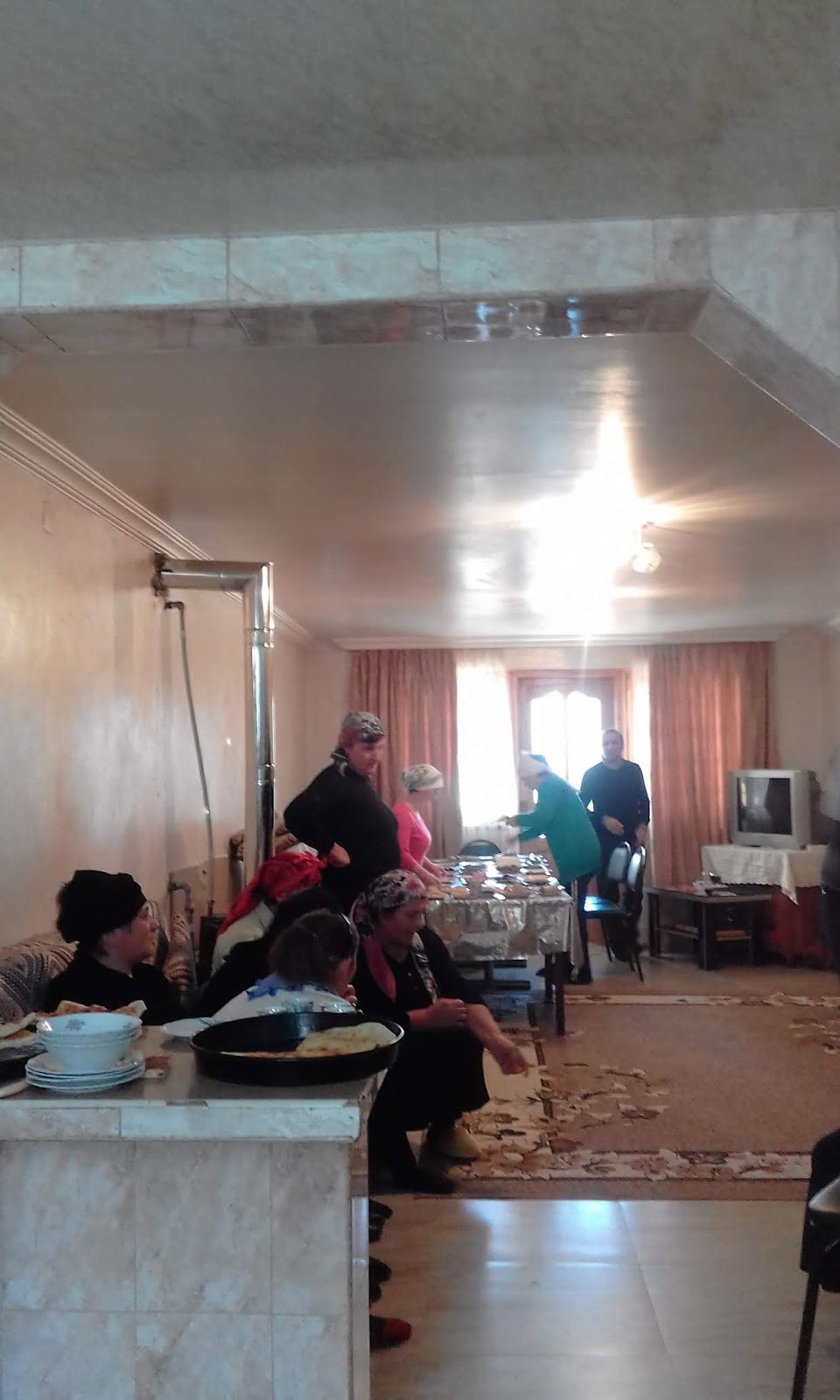
| Waiting - 29 guests for Mawlid (Keda 2017) |
Addendum: events that have featured more religious activity here than either Eid: funerals and Mawlid (მევლუდი), Mohammed's birthday and a holiday that very conservative denominations of Islam reject. Both of those events had an imam come to the house for prayers. For my host great-grandmother's funeral, the imam said some words over the body inside with the women (who sit and mourn around the coffin for days), before going outside and leading an actual prayer with the men, who stood hands up in the rain. Her shroud was green, with Arabic writing and a picture of the Grand Mosque of Mecca, the most overtly Islamic symbols I'd seen in our house aside from the Quran that's kept in our top kitchen shelf. During the Mawlid prayer was the only time I've had to wear a head scarf for anything Islam related in Georgia - you have to wear one in Orthodox churches, but apparently not in mosques here if you're just looking around. In conclusion, different countries are different places, and I'm not shocked that a religion as big as Islam is practiced in different ways, but I love having the opportunity to see these different traditions, to try to understand why they're there, and to keep learning.
 |
| My host grandmother's headscarf and prayer rug, my host great-grandmother's shroud (Keda 2018) |
 |
| Mawlid feast (Keda 2017) |
 |
| Bonus pic for anyone who finished reading this: host grandfather Shalva, Eid al Adha 2017, Keda |