Sunday, April 1, 2018

Georgia's (Probably) Most Famous Export: Mineral Water

Image taken from the website of the Ministry of Foreign Affairs of Japan.
Mineral water is Georgia's most famous export, especially in the former Soviet Union. While La Croix has become recently trendy in America, mineral water (and here I am discussing the sparkling kind) has come nowhere close to reaching the ubiquity it has in Georgia. It's on every supra table (feast), it comes around at funerals, it pours out of springs across the country, and there's an amusement park centered on mineral water in the town of Borjomi. It is also considered an excellent hangover cure. It's most commonly served in 500 to 750 milliter bottles that you pour out into small cups (4 ounces?). If you're at a supra you just pour it into your own cup. If you're at a funeral or otherwise sitting in a place where not everyone has a cup it will be poured for you, the pourer will wait for you to drink it, and then refill and continue on to the next person.
Source: Ministry of Foreign Affairs, Japan
Source: Mr. Wilson's History Website, Liberty Middle School

Since it's already been mentioned, we'll start with Borjomi, the most famous of Georgia's famous mineral waters. This one comes from a town, Borjomi, in the southern Samtskhe-Javakheti region. People travel to the town in hopes that the water will cure their ailments, and a small tourist economy has grown up around the springs, including the aforementioned park with a cable car, and ferris wheel, a public spigot where a grumpy lady will fill any size bottle you hand her with water, and a museum in the former bottling factory. The spring was apparently discovered and bathed in thousands of years ago, and then rediscovered by the Russian army in 1829. Exports of Borjomi began during the imperial period and continued during Soviet times, reaching around 400 million bottles annually in the 1980s.
All u can drink.
As far as the taste of Borjomi goes, it's one of the saltier ones around. Some days it's a little too salty for me, and some days I love it. This drink is not super popular with the American crowd, but is with the Georgian and Russian ones. A fellow PCV says: "Borjomi is like on the bottom of my list because it's so salty. Also because it's so popular and I don't do mainstream shit." It's not the most bubbly and goes flat pretty quickly. The bubbles are pretty average tbh - medium size, middle-of-the-road frequency. I almost never buy Borjomi, but if I'm at a conference at a fancy hotel and they put bottles of it on every table I will take them all. The glass bottles are nice but probably not worth the extra 20 tetri or whatever they cost more than the plastic ones. Also comes in cans for some reason, so they get extra points for being widely available, and for coming in a wide range of containers. 7/10
A Borjomi branded cable car in the Borjomi Mineral Water Park in Borjomi.
Pic and science stolen from Rakuten.com

Likani is the saltiest and more minerally tasting of the bunch. I've heard it compared to "drinking blood," or to "licking a rock," and a number of Americans I know won't drink it. I will if there's not other option, but it's not my favorite, and also probably too salty for everyday consumption. If you're really looking for that straight off the rocks vibe or are feeling mineral deprived, this is the drink for you. If not, look elsewhere. Honestly it's been so long since I drank this that I don't even remember the bubble quality but I feel like they were sparse. When I do drink this in large amounts I think constantly about how much extra sodium I don't need. This also comes from the town of Borjomi, from an area called Likani, which is also home to a Romanov Summer Palace that was later frequented by Soviet officials including Josef Stalin. Likani has a nice blue-green bottle, but I've only ever seen it in the 500ml size. It's widely available. 4/10

The author color-coordinating with Likani Palace a long, long time ago.

Nabeghlavi is by far the most popular brand of mineral water in Peace Corps. It's minimally minerally, has a nice amount of bubbles, and has an excellent advertising campaign. It's widely available, and the bottles have a weird yellow-green color scheme but it's ok. It apparently comes in cans but I've never seen them. Also it's from Village Nabeghlavi the region next to mine, Guria, and obviously the closer anything is to Adjara, the better. This water had an 8/10 but then I found out that apparently the spring was discovered in 1905 when local buffalo showed a preference for this water. 9/10
A Nabeghlavi ad taken from their Facebook page
Another high quality ad.
I am so persuaded by this advertising. 

Sairme is an ok bottle of water. I bought it once to try something new but it was a hot Batumi day and it was warm before I opened it, not a good start. It got flat pretty fast too, but it didn't have a super strong mineral flavor, which is nice when you really just want to hydrate and not turn into a human salt lick. The second time I got a bottle of this I waited too long to buy my train ticket and second class was sold out, so I had to pay an extra 26 lari for first class. The only thing different about first class is your chair is a lil bit bigger and you can get a bottle of mineral water but you have to know it's happening and go get it before they run out. Definitely not worth 26 lari. My rating of this water is tainted by bitter memories. It's not widely available and I've only seen in in plastic half liter bottles but has a nice deer logo. It's from Sairme, a resort outside of Kutaisi in Imereti, where it was purportedly discovered by two hunters following a wounded deer sometime in the 1890s. 5/10
Some people like it more than me I guess, pic borrowed from Caucasus Business Week.

Kokotauri is the best water on this list by far, and it's probably not just because the spring is 5 minutes from my house. It is not super minerally tasting and it has large bubbles in large quantities. It's very refreshing. The label has a nice picture of the local forest on it. It comes in one and two liter plastic bottles, and can only be purchased in the Keda Municipality as far as I can tell. In news that won't shock anyone who read the rest of this post, it's bottled in Village Kokotauri, and was first bottled in 1972. It has apparently been "branded by the people" as the Water of Immortality. The company's web presence is low and there do not appear to be images of the bottle online but it's the one with the forest on it. It also says Kokotauri in three languages, so if you want to, you can figure it out, and you should. It's the best. 10/10
I guess I've never actually taken pics of Kokotauri, but it's in the distance somewhere.
Just kidding, I apparently have a pic of the bread stand, but they painted it blue this morning.

Honorable mention: my village once had a bottling plant for Kemisi, a brand I can find no other information about. Awarded a posthumous 10/10
An old sign.

P.S. Please comment with any mineral water fun facts, opposing opinions, brands I missed, or sketchy springs you think I should drink from!

Wednesday, January 3, 2018

Winter

Chillin' with my sitemate on Georgia's best proportioned bridge.
I guess I forgot about November and December, they flew by like this year has. Winter has fallen in large clumps of soggy snow, sliding off the roof at me every time I go downstairs to the kitchen or bathroom. It took about 3 days for me to get over the excitement of living in the snow for the first time ever - my first time seeing snow flakes! Understanding that snow can be soft, not the clumpy icy stuff that we visited on my middle school ski trip! I am now eagerly awaiting late spring, only 5 or so months away. The snow also seems to have scared off our relatively consistent electricity - during the summer we had occasional power outages, but lately it's felt more like we have occasional power. The lack of electricity has been one factor inhibiting my blogging (and working more generally). Without lights or my electric heater, my hands freeze and my computer dies and I just go to sleep and pretend that I'll wake up early and there will be power and I'll do my work then. That never happens.

Snowy days in Sataplia, just outside of Kutaisi.
On the plus side, the winter schedule started in mid-November, and now school starts at 9:30, a blessing for me, since I am deeply troubled by having to wake up before the sun. Unfortunately our school's heating also requires electricity, so when the power is out our classes are only 1/2 an hour each, because it's too cold and everyone wants to go home. On the first day it really snowed school was canceled at 12 because there were only about 6 students there, and 6 teachers, and we did shots in the school kitchen instead. Today I followed a student to the very crowded guard's shack in the yard (he has a petchi/woodstove) and made her speak English with me there, since I felt like I couldn't force her wet and cold self to come inside and actually attend the lesson and also catch pneumonia. I have a waterproof hood-to-ankle coat that I thought was absurd while purchasing it in the depths of northern California weather, but I have since changed my mind. Now all I need are waterproof shoes, and about 7 more pairs of wool socks. Apparently we have a school bus only when the weather is nice - when there're more than 6 inches of snow we walk.

But really, snow camping in a dinosaur park is something everyone who visits Georgia should do.
Sneaky pics of the GLOW Georgia Mother-Daughter Conference in Kobuleti.
Since October I've gone camping in the snow at a dinosaur park, been to a language training and reached "Intermediate High" level in Georgian, written my first real grant, been rejected for my first real grant, tried unsuccessfully to write an article about a scientist, been to a lot of meetings, visited Kvishkheti, Zestaponi, Kutaisi, Batumi, Tbilisi, Tserovani, and Kobuleti, lost my computer, had my computer returned to me by a very kind Giorgi, celebrated the prophet Muhammad's birthday with my host family (weeks after Muslims in other countries did...), helped organize a conference for rural mothers and daughters, helped organize a meeting on diversity issues in the Peace Corps community, quit the Peace Corps Georgia Diversity Working Group, attended more trainings, and eaten about 40 potato piroshki. More details about these events may or may not follow.

L-R my counterpart, me, and another teacher from Adjara at the Tyrell Corporation HQ in Tbilisi for training.
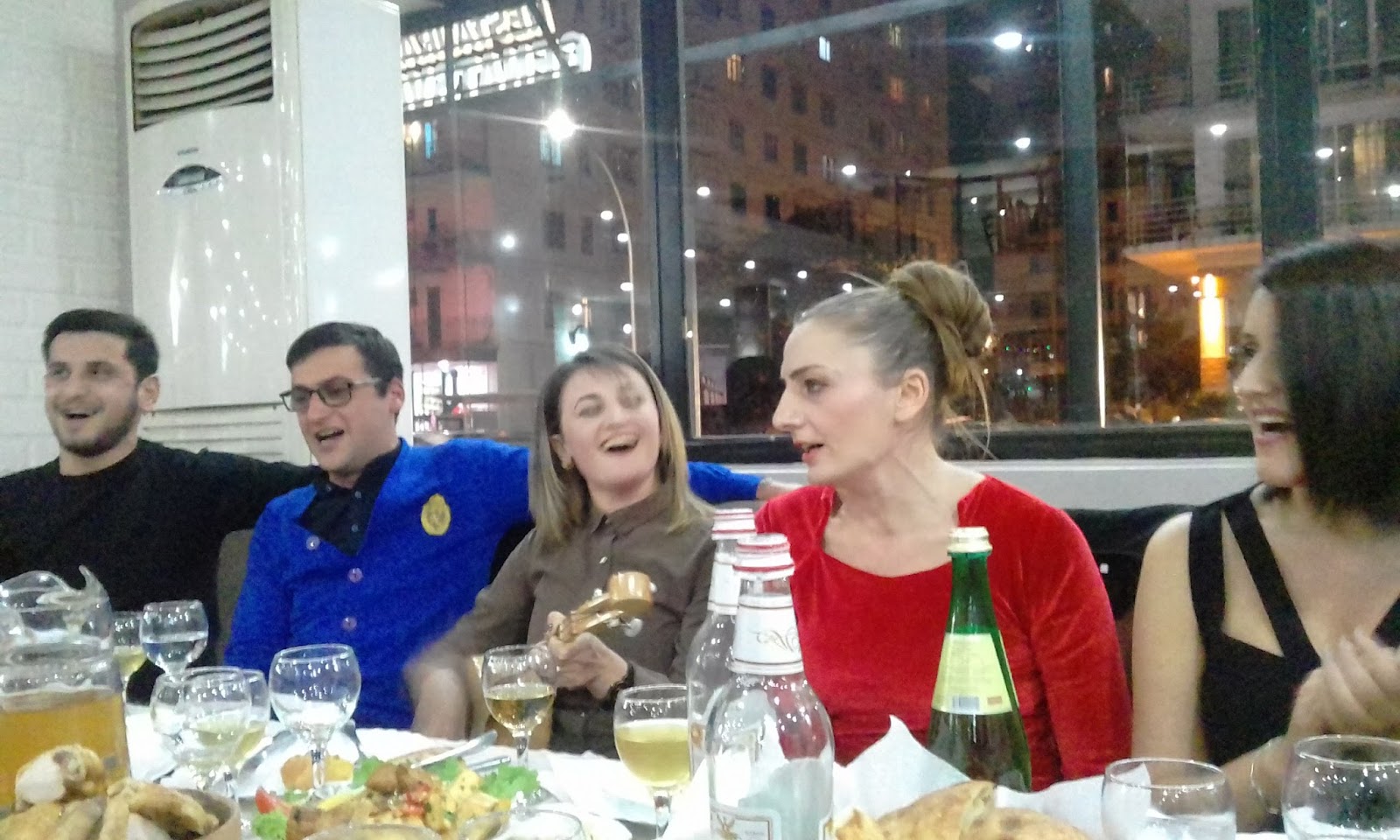
Feasting and singing and dancing with my coworkers at my counterpart's birthday party.
Fruits of November in Batumi - pumpkins, persimmons, quince, mandarins, kiwis, and guavas.
For now, I'm adapting to a new mode of life, working while sitting on the floor a foot from my electric heater (oh wait, I did that in California too, I just didn't realize how warm it was there...). Summer and fall's vegetables and fruits are gone - just a few last wrinkly grapes, and some persimmons and pears are left. I've heard that it's just cabbage and potatoes from here on out, but we've started eating the canned foods - canned salad, adjika (red pepper sauce), tomato preserves, pickles, jam, and compote, so far.  There's random cloth stuffed in the large holes in my windows, I put scotch tape over the smaller ones, and my host family re-did their roof so my plants are no longer self-watering. I've moved all of my plants and a few of my host family's into my room, which I think is nice but the fam definitely thinks is a little odd. Every week or so I go to the unoccupied section of the house next to mine with 14 beds and steal another blanket.

6th grade, very proud of their snowman.
Georgians celebrate New Years as the big winter holiday, and my school has been getting ready for an end of the year concert and I've been decorating my classroom with my students. I'm apparently a fun enough teacher that kids come to my classroom during breaks, and since I've struggled to organize after school activities at my tiny school, I've been working on utilizing those times for "cultural exchange" or whatever. When I was a kid, pre-Rugby thumb injury, I was a master snowflake artist, so I've been teaching any students that want to learn how to make them. Paper crafts seem very popular  here - my counterpart made a very fancy paper tree, my host mom showed me how to make some cool paper star decorations, and my host sister has been showing me endless videos of paper things that she wants me to figure out how to do with her. I'm content with snowflakes though, and delighted that students of all genders and ages seem interested in making them, though perhaps not quite as interested in cleaning up the tiny pieces of paper that are everywhere afterward. Sometimes when only one student shows up to class I make them make snowflakes too and teach them useful vocabulary like "I'm freezing," "cut," and "fold," since we'd have to re-do any book work once the rest of the students returned anyway. In addition to decorations, my director requested that I teach some students an English or American song for the Christmas/New Years show, so now I, the atheist English teacher, am teaching a predominantly Muslim group of students "Silent Night," because I try to make my director happy, and the students really enjoy singing. They also wanted me to teach them a song called "Last Christmas," but I had never heard it before and it has a lot more words in it, so we've agreed to postpone that for next year. Unfortunately Georgian winter break starts on the 29th, so I'm leaving early to celebrate American Christmas with my Thai father in Thailand and I will miss the show, but I will be warm.

My classroom.
The Bagrati Cathedral in Kutaisi, Georgia's best known former UNESCO World Heritage Site...

Wild horses in the snow in front of my house, apparently if I want one all I have to do is feed it corn.
Me & the park rangers' snow dog at Sataplia.

**PS this post was written in early December & I forgot to post it but here you go

Wednesday, October 4, 2017

Sezonebi/სეზონები

October in Jalabashvilebi: Summer ended late but suddenly.
There are two words for "season" in Georgian, and I want you to know that I know them both, sometimes. As I sit here shivering in two wool sweaters I still vividly remember packing away my winter clothes, how did summer pass so quickly?

Mariam & Anano, Kvishkheti in early June
One thing that I've really enjoyed here is experiencing seasons. Northern California really just has the more fog and less fog seasons, and sometimes not even that, New Orleans' hurricane season and snoball season and Mardi Gras season and festival season were mostly lovely, monsoon season in Thailand less so. Here, for the first time, I am experiencing the kinds of seasons that I've seen in movies and read about for my whole life. A cool spring, and then green and flowers, then a hot beautiful summer, then a too hot September, and then suddenly it's fall and leaves are changing color and petchis are roaring and it's cold. I thought it would be best to write this post before I experience winter, because my feelings will probably be less enthusiastic.

May in Bublisitkhe.

Ice-cream walks with Diana, nowhere, Shuakhevi, July.
Studying a language in its native country for longer than a few months is a wonderful experience. I studied abroad in college but for shorter periods of time, and unfortunately with less commitment to studying and understanding the people I lived with. Here, whether I've matured or just have fewer options for distraction, I study for an hour every day and hang out in the teacher's lounge and spend time with my family, and keep learning (and sometimes I look at my phone and don't learn as much). One of my favorite things that I've noticed about language learning and time here is that it slowly teaches you the words you need to know, as you need to know them. Unfortunately, the word of this season may be umbrella. During pre-service training (PST), I struggled to remember certain important words - cheese, grapes, job. When I got to site, it was watermelon, desk, the name of the village I might live in. Soon it'll be snow and frost. To combat this difficulty, I study. I have flashcards and verb charts and a notebook for new words and all of that fun stuff, but really time does the job best.

I got here in April, but it was still winter. Datchi in Kvishkheti.
Picking cherries with Datchi, Kvishkheti, May.
Our textbook has a giant list of food words, and I made a flashcard for each of them, but the ones that I never eat, I never really learn. There's still one in the pile for "dried, hardened bread a la crouton," because I have been fortunate enough not to encounter it yet in the non-book world. Instead, I learn them at the beginning of the seasons, when I go out to the garden or field with the family and try to understand what they're telling me to pick or when my host sister is still excited about watermelon, or grapes, and comes up to my room to tell me to come downstairs and eat some with the family. I never say no to a fruit invitation.

October grapes in Kvishkheti
Roadside fig, Diana's hand, September in Mosiashvilebi
My persimmon flashcard that's been floating around for months is finally approaching the end (I have a system that involves getting a flashcard right 6 times before I cross out the word on it and use it again). "Khurma," (ხურმა) a delicious word for a fruit I don't really like that much. You can also call them "karalioki," (კარალიოკი) but I think that's Russian and I don't like that word much. In a non-coincidence, the persimmons outside of my bedroom window are ripening, and the first slightly-greenish ones have just reached the bazaar. By the time they are fully ripe I will never forget the word for persimmon, as I will remember cherry, plum, strawberry, watermelon, hazelnut, fig, grape, corn, and pumpkin, in that order. I'm looking forward to pomegranate and chestnut.

Red leaves coming toward Dandalo, September